A Potted History
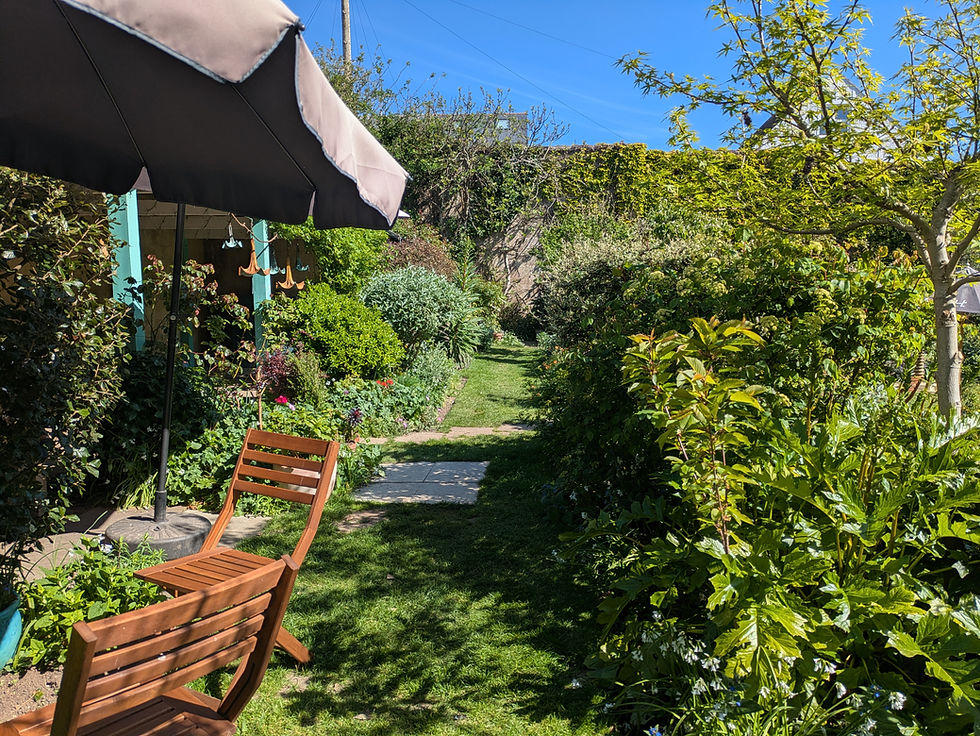
Hidden behind high walls in the heart of Kemptown lies a rare and remarkable survivor — a garden shaped by nearly two centuries of history, preserved today as a place of quiet beauty, creativity and community.
Origins: A Private Regency World
The Kemp Town estate was conceived and financed by Thomas Read Kemp, in the 1820's, to provide high class housing for the wealthy population of Brighton, and also its seasonal visitors. It became the ultimate fashionable seaside resort, offering aristocratic society, health conscious sea bathing, and a liberal, bohemian social life, close to Brighton. People also flocked here because of the patronage of the Prince Regent (later George 1V), who built the exotic Royal Pavilion.
The KempTown Estate was built on the Brighton cliffs, by a team, led by the builder Thomas Cubitt, and designed by the architects Charles Busby, and Amon Henry Wilds. Work began in 1823 and the Estate was finally completed in 1855.
The 'Secret Garden' in KempTown has a fascinating history, and was designed as a private walled pleasure and kitchen garden. The houses from numbers 32 to 40 Sussex Square accessed their gardens through a subterranean tunnel, from their appropriate house, underneath Bristol Road. There are at least four other tunnels, the Secret garden is not the only tunnel, under Bristol Place. Its defining and surrounding walls were also built at the same time and were designed to create a "sunken" effect.
Innovation In Stone
The garden's structure and fabric are also linked to the inventive Regency builder William Ranger (1799-1834), a Sussex born builder, who invented and experimented with artificial stone (an early concrete mix).' Ranger Artificial Stone' was patented in 1832 and 1834, by Ranger who by 1824 was working in Brighton for the architect Charles Barry, and using his innovative construction methods in Brighton. It followed a trend nationally, and indeed in Europe, to develop cheaper, mass-produced building materials, prompted by the rapid acceleration in building and advancing technology. Rangers material, which could be moulded into blocks and cast in-situ as a solid mass, thus made him a pioneer in terms of both concrete block and monolithic construction. Various trial formulas were used in his Brighton projects, making the town a unique repository of the material's experimental development, this instance at the Secret Garden being an early, or possibly the earliest example. It is a rare example where the 'stone' is in its original condition, as the internal surfaces have not been rendered.
According to an article in J C Loudon's Architectural Magazine in 1835 (vol 11, p 62-63), the first work executed in this new material was a wall surrounding the garden of Mr Peel of Kemp Town, who became a prominent landowner and patron in Kemp Town.
A Story Of Survival
Laurence Peel ( younger brother of the Prime minister Robert Peel) acquired 32, Sussex Square in 1830, and was the first 'notable owner', becoming a long term resident. The garden was designed and laid out from the mid 1820's, and was built to serve 32, Sussex Square.
'The Secret Garden', is the last of these gardens to remain, leaving it as a hidden walled space in the midst of Kemp Town. The other linked gardens were built over, in the passage of time. During the 19th century, many other such gardens existed in Kemp Town, but most were later built over, as the city of Brighton expanded. The current walled garden represents about a third of the original garden, which extended from Bristol Place to Arundel Road. Over time, the wider garden was divided, and much of it was lost to development, but this surviving plot remained. In 1898 the glass houses in the kitchen garden were not shown on the OS map.
In 1900, 32 Sussex square was put up for sale, the garden was split into two separate plots; house, plus pleasure/kitchen garden
Details of the sale included:- The house and pleasure garden, carriage house and stables.
The remaining gardens from Bristol Place down to Arundel Road. A bungaroosh wall divided this area in two. At the end of the secret garden was the pleasure garden which had a fives court, a tennis lawn, a summer house, a smoking room; situated at the the southern end of the existing pavilion building was a toolhouse and a water closet (W.C.). There was a large and productive walled-in kitchen garden, beyond the bungaroosh wall. It was well planted with fruit trees etc, a 29ft long vinery, hot water pipes, potting house and a shed. These buildings were located at the Arundel road end.
The mouth of the tunnel was to be blocked by 9 inch thick bricks, within one month, of the sales completion. These were the required conditions of the sale, for whoever purchased the two lots.
In 1911 the kitchen garden (eastern plot) in use as a nursery garden, on the map, the owner wasa private occupier (nurseryman or small landowner). This person was the most likely mortgagor.In 1920, the house was sold again; only the house and the smaller pleasure garden were part of the sale. In 1900 it seems as if the grounds had been split into two different lots, as the gardens to the east of Bristol Place were not included in the 1920's sale. By 1925, 32, Sussex Square had been converted into flats, and they remain that way, today (2026).
In 1928 the Baptist Union Corporation became the mortgagee and secured legal interest in the land. This implies the nursery land owner borrowed money, secured on the land. The Baptist Union Corporation held a legal charge (mortgage) and possibly took possession after default. This strongly suggests that the corporation had influence and control over both sides of the old garden.
From 1928 until 1950 the Baptist Union transitioned from mortgage holder to being the effective owner. This was likely due to either foreclosure, transfer in lieu of debt or purchase following default.
In 1910 No.13, Arundel house, Arundel Terrace became a rest home run by the Baptist Union corporation (The Spurgeon Home of rest) primarily for Baptist ministers and their wives.There are some photographs in existence, of residents enjoying the delights of the secret garden, playing tennis and crochet on the lawns, the location given as the New Gardens, Arundel House, Home of Rest. These photographs and accompanying text are certainly proof that the garden did indeed now belong to the Baptist Union Corporation.
In 1931 extensive glass houses were shown on the map of the garden, and in 1953 the glass houses were still there, on the garden map.
In 1950 the 'Secret Garden' was purchased by Antony Dale, who founded the Regency Society in Brighton, in 1945.The Regency Society campaigns for Brighton and Hove's past and future heritage. Antony Dale purchased the Secret Garden from the Baptist Union Corporation Limited. They still controlled at least part of the land and had full legal title, and not just a mortgage. It is not known how the Baptist Union came to own the land belonging to the Secret garden and other covering land directly adjoining Bristol Place. But, on a 1911 OS map, there was a Gospel Hall Church. It was situated on the corner of Bennett Road and Bristol Gardens, opposite the north side of the Secret Garden. So, possibly the church may have owned other land nearby. The Gospel hall church was probably demolished in the first half of the 20th century. A conveyance in 1928, of land now occupied by Rugby Court to the Baptist Union contains a covenant relating to the area next to the Bungaroosh wall, suggesting that at one time they controlled the entire former kitchen garden estate, belonging to 32, Sussex Square. This was not incidental ownership, it was structured and they had legal control of a significant parcel of the estate. The original large garden was already in two parts and the old kitchen garden part still had lots of glass houses, shown on the map. This part of the garden, on the other side of the bungaroosh hall was not developed until 1972, when Rugby Court flats were built.
Preserved For The Future
Antony Dale resided in Sussex Square, on the KempTown Estate and he was an author, historian and conservationist. He cared for the garden and helped to preserve it, along with his wife,Yvonne Dale. Following his death in 1993, his widow, Yvonne gave great consideration to the future of this valuable piece of land in central Brighton. It was Yvonne's wish, and that of Antony's, that this very special garden should remain as a haven for the community and others and to host sculptural exhibitions. Yvonne was a staunch supporter of the Regency Society, and she approached Gavin Henderson CBE, a notable Brighton resident, and former artistic director of the Brighton Festival. Gavin was the chair of the Regency Society at that time, and the Society held their annual party in the garden. They felt inspired to create a sculpture park within a beautifully planted English garden, to be run by a board of Trustees and with the support of volunteers.
English Heritage has recognised its significance with Grade II listing, and today it is a protected historic site, which helps safeguard its walls and historic features, for the future. It functions as a volunteer-led community sculpture garden- still hidden behind high walls, much as it was nearly two centuries ago.
The Garden Today
What began as a private Regency-era pleasure garden for an elite townhouse, survived urban development that erased similar spaces, and has been preserved into the present, as a rare historical and cultural oasis.
The Secret Garden is run by the Antony Dale Trust, a registered UK Charity (1124822), governed by Trustees, and is sustained on public donations and charitable support, to help fund its current work and future.